November 3, 2026
Share This Story, Choose Your Platform!
Tuesday, November 3rd, is Election Day, when millions of Americans will head to the polss to vote in the midterm elections. The last time I voted I was living abroad in the UAE, where I spent four years. So voting back in the states this year is a pretty big deal for me.
And I’m not the only person that’s making a big deal out of voting.
It seems the topic of voting has crossed over into my field, dating and relationships, where people are discussing whether they could date someone or remain in a relationship with someone who votes a different political party.
Based on some of the conversations I’ve seen online, women seem particularly reluctant to date across political lines, especially when the political partner voted for Donald Trump.
I wondered why there appeared to be such a disparity between men and women, so I decided to do some investigating.
The first thing I did was create a poll for my mailing list, asking readers which political group they believed would be most willing to date someone from a different party.

The second thing I did was research what might contribute to someone’s willingness, or unwillingness, to date across political lines.
And here’s what I learned.
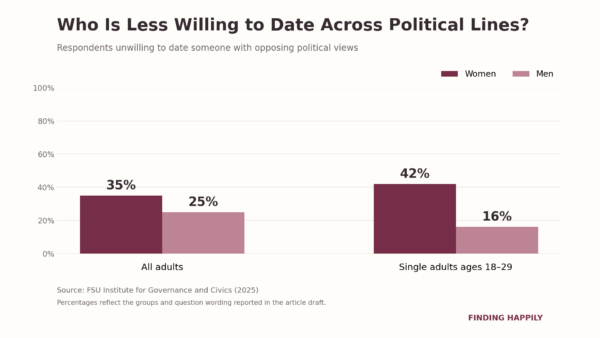
According to a 2025 survey conducted by Florida State University’s Institute for Governance and Civics, men were more willing than women to consider to date across party lines.
The researchers found that 35% of women and 25% of men said the would not date someone whose political views differed from their own.
Among single adults between the ages of 18 and 29, the difference was even greater. Forty-two percent of women said they would not date across political lines, compared to just 16% of men.
Are Men More Willing to Date Across Political Lines?
According to a 2025 survey conducted by Florida State University’s Institute for Governance and Civics, men were more willing than women to consider to date across party lines.
The researchers found that 35% of women and 25% of men said the would not date someone whose political views differed from their own.
Among single adults between the ages of 18 and 29, the difference was even greater. Forty-two percent of women said they would not date across political lines, compared to just 16% of men.
The study also found that people with stronger political ideologies were generally less comfortable with political differences than people with more moderate views.
These findings made me wonder why women, especially younger women, appeared less willing to consider someone with opposing political views.
Could it be that women believe they had more to lose?
For instance, when women vote they consider women’s rights, reproductive freedom and their right to choose.
Men may share some of those concerns, however other issues, such as the economy, gun rights and public safety, might carry more weight in their voting decisions.
I don’t like to believe we should assume what who someone will vote for simply because of their identity or gender. But I do think it’s worth asking whether the policies affect people differently.
Is It Really About Political Parties, or Is It About Donald Trump?
Something else I noticed while reviewing the research was that people seemed to distinguish between dating someone from another political party and dating someone who voted for a particular candidate.
According to Pew Research Center survey conducted in 2019, 43% of Democratic daters said they would not consider a committed relationship with someone who identified as a Republican.
However, when asked about dating someone who dated for Donald Trump in 2016, that number increased to 71%.
Republican daters showed a similar, although smaller, difference. Twenty-four percent said they would not consider dating a Democrat, while 47% said they would not consider dating someone who voted for Hillary Clinton.
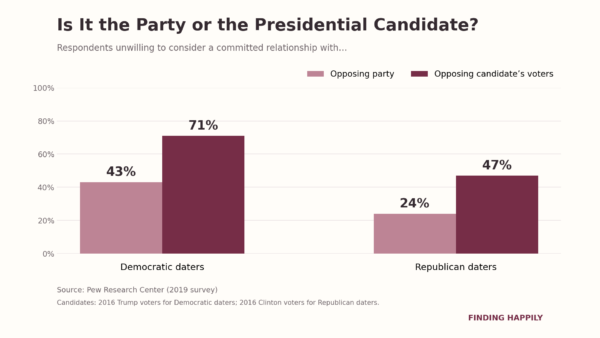
This made me wonder whether the divide has become less about political parties and more about what people believe supporting a particular candidate says about their values.
After all, someone might identify as a conservative but not support Donald Trump. Likewise, someone might identify as a liberal but disagree with certain Democratic policies.
So, is it really the party that matters, or the candidate and what that candidate represents? Or, is it the policies under said party?
When Did Political Differences Become Relationship Dealbreakers?
As an Independent, I remember voting for candidates from both parties, although I’ve tended to favor one party over the other.
I also remember when people in the same household could belong to different political parties and still have discussions about their choices.
Of course, those disagreements weren’t always pleasant. But today, it sometimes feels as though those differences are enough to end friendships, divide families eliminate someone as a potential romantic partner before the first date
The research suggests that particular candidates can make a difference in people’s willingness to date across party lines. What it doesn’t tell us conclusively is whether Americans were more accepting of political differences twenty years ago than they are today.
Still, I cannot help wondering whether our political identities have become so intertwined with our own personal identities that people now interpret a vote as a statement about who someone is.
Beliefs, Values, and the People We Choose to Love
As a dating and relationship coach, I often talk about the differences between values and beliefs.
I sometimes refer to belie systems as our B.S.
Our beliefs can change as we learn, grow or experience life. Our values tend to run deeper. They influence our core essence, how we see ourselves, how we see others, and what we’re willing or unwilling to accept in our relationships. They are usually the framework for what we consider a pet-peeve or a deal-breaker.
For instance, two people may disagree about taxes, government spending, or certain policies and still share the same fundamental values.
But what happens when their disagreements involve equality, personal freedom, body autonomy or how they believe they, or other people should be treated.
At what point does a political difference become a values conflict?
And perhaps an equally important question is whether we’re taking the time to understand what someone actually believes, or are we simply making assumptions based on the party or candidate someone supports.
I’m not suggesting that anyone should compromise their own values to find or maintain a relationship. But I do think we need to ask the right question and have the difficult conversations to learn where someone truly stands before we assume we already know everything about them.
Could You Date Across Party Lines?
Finding love or maintaining the love you already have, can be challenging enough without adding political disagreements to the equation.
And with the holidays approaching, many families and couples will find themselves navigating conversations that could become uncomfortable or even contentious.
For these reasons, later this month, I’ll be sharing some practical ways to have these difficult conversations in my newsletter, so make sure you subscribe to our mailing list if you haven’t already.
For now, I’m curious about what you think.
Would you date someone across party lines? What if that person voted for a candidate you strongly apposed?
And if you’re already in a relationship with someone whose political views differ from yours, how do you make it work?
I’d love to hear your thoughts.
Research Referenced
- Florida State University, Institute for Governance and Civics (2025).More Than Politics: How Ideology Shapes Who Americans Trust, Date, and Avoid.
- Pew Research Center (2020).Most Democrats Who Are Looking for a Relationship Would Not Consider Dating a Trump Voter. Based on survey data collected in October 2019.

Collette Gee is a Dating & Relationship Specialist and Author, that helps women and men create and sustain healthy, meaningful relationships be it: romantic, family, platonic, or professional. Her mission is to help people love harmoniously and successfully.